
I benchmarked KeyDB and Garnet too — one hit a wall, one broke my assumptions

A follow-up to my Dragonfly vs Redis vs Valkey series. Same harness, same bare-metal approach — but this time I pointed it at the two engines almost nobody benchmarks independently: KeyDB and Microsoft's Garnet. One of them surprised me enough that I double-checked the numbers three times.
When I published the Dragonfly benchmark, three different people asked the same question in the comments: what about KeyDB? what about Garnet? Fair. So I ran them — on the same methodology, so the numbers actually mean something next to the others.
Short version: KeyDB hit a hard ceiling I didn't expect, and Garnet posted a number I didn't believe until I'd verified it wasn't an artifact.
The setup (and one honest caveat up front)
Single-node, read-heavy (1:10), 100-byte values, 1M keys, pipeline 16, client-side latency, medians across repetitions. The engine box was the same 48-core c7i.metal-24xl as my earlier benchmark.
The caveat: this session's load-generator was an AMD c7a.24xlarge — the Intel client I'd used before had no capacity in the availability zone that evening. That matters, so I'm stating it loudly: the reference numbers shifted (a normal cluster-mode memtier client hit 6.9M here vs 4.6M in the earlier run — same server, different client, which is itself a lesson about where cluster bottlenecks live). Every comparison below is within this one session, on these exact machines. I'm not mixing it with the earlier capture.
Engine versions: KeyDB 6.3.4, Garnet 2.1.6.
KeyDB: a wall, not a slope
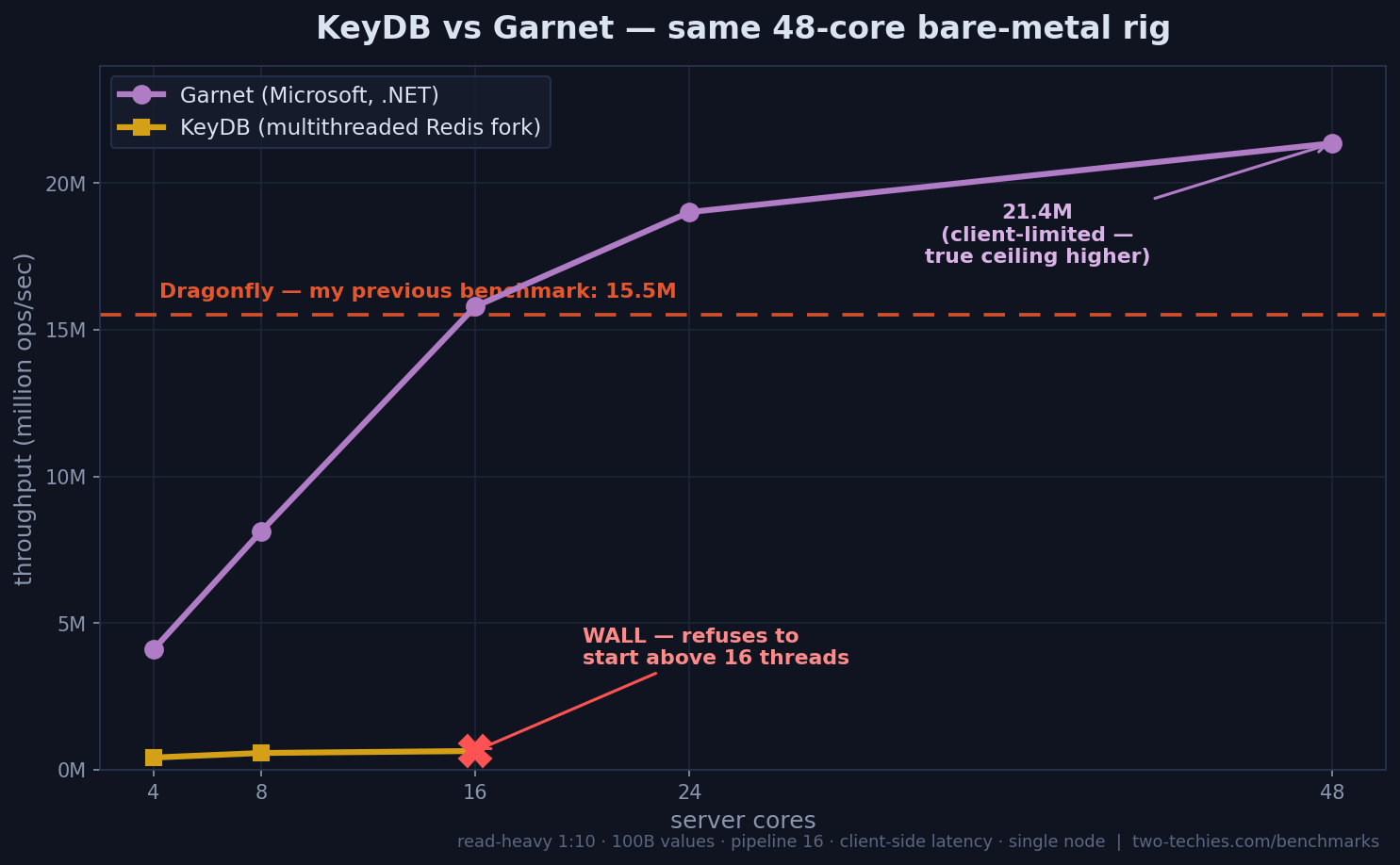
KeyDB is the multithreaded Redis fork — its whole pitch is "Redis, but it uses your cores." So I expected a clean scaling curve. Here's what I got (read-heavy, pipeline 16):
| cores | throughput |
|---|---|
| 4 | 413K ops/s |
| 8 | 569K ops/s |
| 16 | 636K ops/s |
| 24 | won't start |
| 48 | won't start |
Two problems. First, the scaling is weak — doubling from 8 to 16 cores bought 12%, the signature of contention. Second, and more surprising: KeyDB 6.3.4 refuses to start with more than 16 server threads. Not a slowdown — a fatal config error:
*** FATAL CONFIG FILE ERROR (KeyDB 6.3.4) ***
'server-threads "24"'
Invalid number of threads specified
So on a 48-core box, KeyDB's multithreading tops out at a third of the machine, and its latency under load sat around 22–29ms p50 while it did it. It's a real, hard architectural ceiling — and honestly, it's the clearest answer I've seen to "why did Dragonfly rewrite from scratch instead of just doing what KeyDB did?" The fork approach ran out of runway.
(Memory footnote: KeyDB was also the heaviest of every engine I've tested — 200.3 bytes/key vs Dragonfly's 146, Redis's 165, Valkey's 169, at 100-byte values.)
Garnet: the number I didn't believe at first
Garnet is Microsoft Research's from-scratch store, written in .NET. I included it half-expecting a research curiosity. Instead:
| cores | throughput | p50 latency |
|---|---|---|
| 4 | 4.1M ops/s | — |
| 8 | 8.1M ops/s | 1.7 ms |
| 16 | 15.8M ops/s | 0.75 ms |
| 24 | 19.0M ops/s | 0.59 ms |
| 48 | 21.4M ops/s | 0.68 ms |
Almost linear to 16 cores, still climbing at 48, and sub-millisecond p50 the whole way. At 16 cores it had already passed the 15.5M that Dragonfly posted at 48 cores in my earlier benchmark — using a third of the hardware.
My first reaction was "that can't be right — the threads must have escaped their CPU limit." So I checked. I watched server CPU during every run: at 24 cores Garnet peaked at 2204% (of a 2400% budget), at 48 cores around 4000% of 4800% — comfortably inside the cores it was pinned to. Hit rate was 1.0 throughout. The number is real.
And here's the honest part that makes it more impressive, not less: 21.4M isn't Garnet's ceiling. At 48 cores the server wasn't saturated — my client machine ran out of capacity first. I was measuring my load generator, not Garnet's limit. So the real number is higher; I simply couldn't drive it hard enough with one client box. When I say Garnet does "at least 21.4M," the "at least" is doing real work.
What this does — and doesn't — say
I try to be careful here, because it's easy to turn a surprising number into a wrong headline.
- This is single-node. Garnet has a cluster mode I didn't test; these are one-process numbers.
- 21.4M is a floor, not a ceiling — it's client-limited. Don't quote it as Garnet's maximum.
- I left Garnet out of the memory comparison. It doesn't report
used_memorythe way the RESP engines do (it pre-allocates a log and reports .NET GC internals), so a bytes/key number would have been apples-to-oranges. Better to say nothing than to say something dishonest. - Different client than my earlier series — so treat this as its own session, which is exactly how I've presented it.
What it does say: the multithreaded-fork approach (KeyDB) has a real ceiling, and the from-scratch approaches (Dragonfly, Garnet) are the ones actually using modern many-core hardware. Garnet in particular deserves far more independent benchmarking than it gets — I may be one of the first to publish a fair, reproducible number on it, and I'd genuinely like to be proven wrong or right by someone rerunning it.
Explore the data yourself
Every number here is filterable — by engine, core count, workload, and pipeline depth — in the interactive Benchmark Explorer. And the whole harness, pinned image digests, and raw runs.csv are public: github.com/sunnysahijwani/dragonfly-redis-valkey-benchmark. Rerun it and tell me where I'm wrong — that's the point.
If you're new here, start with the main Dragonfly vs Redis vs Valkey series for the methodology and the fairness choices behind all of this.