
Part 6 of 7 · ← Memory efficiency · Next: When to use which →

Part 6. Throughput and latency are what benchmarks measure. This is the thing they usually miss — and it's where Dragonfly's real structural advantage lives. It's also where I have to be most careful to stay honest, because it's easy to overclaim here.
The demo (run it yourself)
Take three plain keys and ask each engine to fetch them in one command. On a single Dragonfly process and on a single Redis, this just works. On a Redis Cluster it doesn't:
Redis Cluster (slots: alpha=865  bravo=8623  charlie=1769)
  MGET alpha bravo charlie      → CROSSSLOT Keys in request don't hash to the same slot
  EVAL over alpha bravo charlie → CROSSSLOT Keys in request don't hash to the same slot
  MGET {u1}:name {u1}:email     → OK   (same hash-tag → same slot)
Dragonfly (single process)
MGET alpha bravo charlie      → OK
EVAL over alpha bravo charlie → OK
This isn't a bug — it's how Redis Cluster is designed. Each shard is an independent process that only holds its slice of the 16,384 hash slots, and it refuses any multi-key command whose keys don't all live in the same slot, rather than doing a slow cross-shard scatter-gather.
Why it matters: multi-key isn't a convenience, it's atomicity
MGET being rejected is mildly annoying — you can do three separate GETs. But the same rule hits MULTI/EXEC transactions and Lua scripts, and those are how you do atomic multi-key logic:
- deduct from
wallet:A, creditwallet:B, all-or-nothing; - check
stock:item, decrement it, writereserved:user— atomically, so two buyers can't grab the last unit.
On a single Dragonfly (or single Redis) you write one Lua script over whatever keys you need and it runs atomically. On a Redis Cluster, that script can only touch same-slot keys — so you must force the related keys onto one slot with a hash-tag ({group}:...). That works, but it:
- concentrates those keys on one shard — you lose the load-spreading you sharded for, and
- forces you to decide, at data-model time, which entities will ever need to be touched together — often impossible to predict.
That's the tax. It's not "Redis is worse" — it's the unavoidable cost of splitting one logical keyspace across independent processes.
Quantified: multi-key throughput
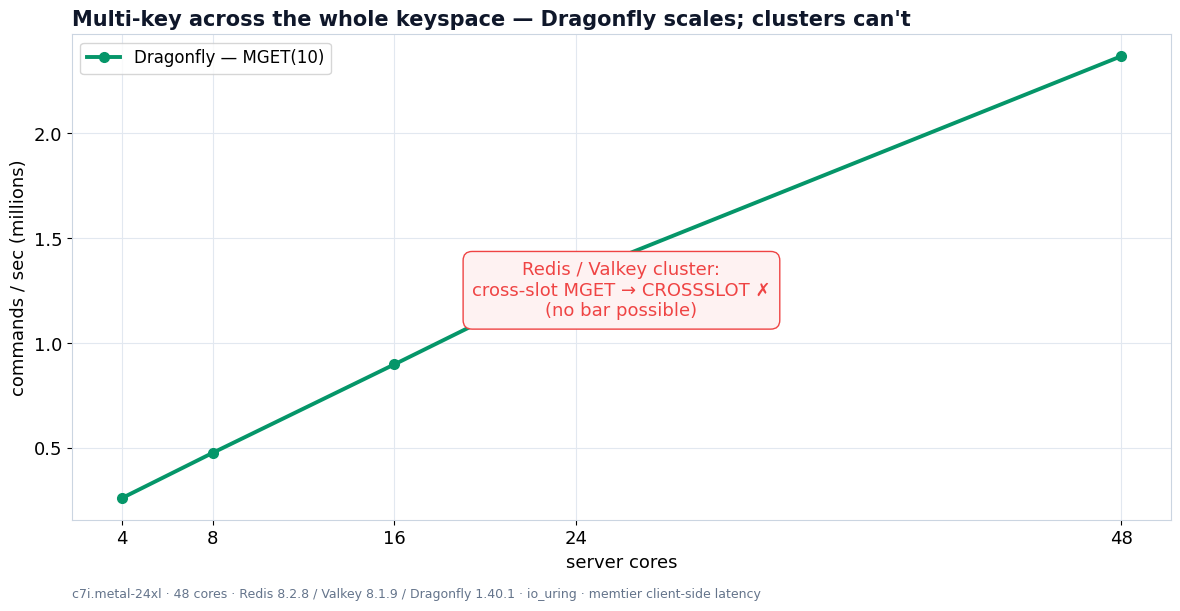
Because Dragonfly handles cross-key ops natively, I could benchmark them — MGET/MSET of 10 keys, scaling with cores:
MGET(10), pipeline 16: 4c → 0.3M, 8c → 0.5M, 16c → 0.9M, 24c → 1.3M, 48c → 2.4M commands/sec (= ~24M keys/sec).MSET(10), pipeline 16: scales similarly to ~1.3M commands/sec at 48 cores.
The Redis/Valkey clusters get no bar on this chart — cross-slot multi-key is rejected outright. To make it work you'd hash-tag everything onto shared slots, which changes the workload (and the point).
The honesty guard — this is important
It would be easy, and wrong, to say "Dragonfly has no sharding limits." It does. Dragonfly Cluster, once you scale it across machines, uses the same 16,384-slot model and returns the same CROSSSLOT error. Dragonfly's advantage is narrower and more honest:
A single Dragonfly node uses all your cores without sharding — so it keeps single-instance semantics (any multi-key op, atomic Lua, transactions) while scaling up. You postpone clustering — and its cross-key tax — until you genuinely outgrow one big machine. With Redis you pay that tax the moment you need more than one core's worth of throughput.
Not "never." Later. For a lot of workloads, "later" means "never in practice," because one big Dragonfly node goes a very long way. But if you truly outgrow a single machine, both engines shard and both hit the same wall.
The takeaway
The cross-key tax is the clearest structural difference between the two designs. Redis makes you choose, quite early, between using all your cores and keeping multi-key atomicity across arbitrary keys. Dragonfly lets you have both on one node. That — not raw ops/sec — is the strongest case for it.
Next: Part 7 — when to use which, where all of this becomes a decision table.
About the author
I'm Sunny Sahijwani — a senior backend & DevOps engineer.
👉 Connect with me on LinkedIn — I'm always happy to talk in-memory databases, performance, and systems architecture.
The full harness, pinned versions, and raw data for this benchmark are public on GitHub — rerun it and tell me where I'm wrong.