
Part 5 of 7 · ← Latency under load · Next: Operational simplicity →

Part 5. The shortest post in the series, and the least arguable number in it — because memory footprint is about data-structure design, not how hard you drive the client. It's the same on a laptop and on 48 bare-metal cores.
The measurement
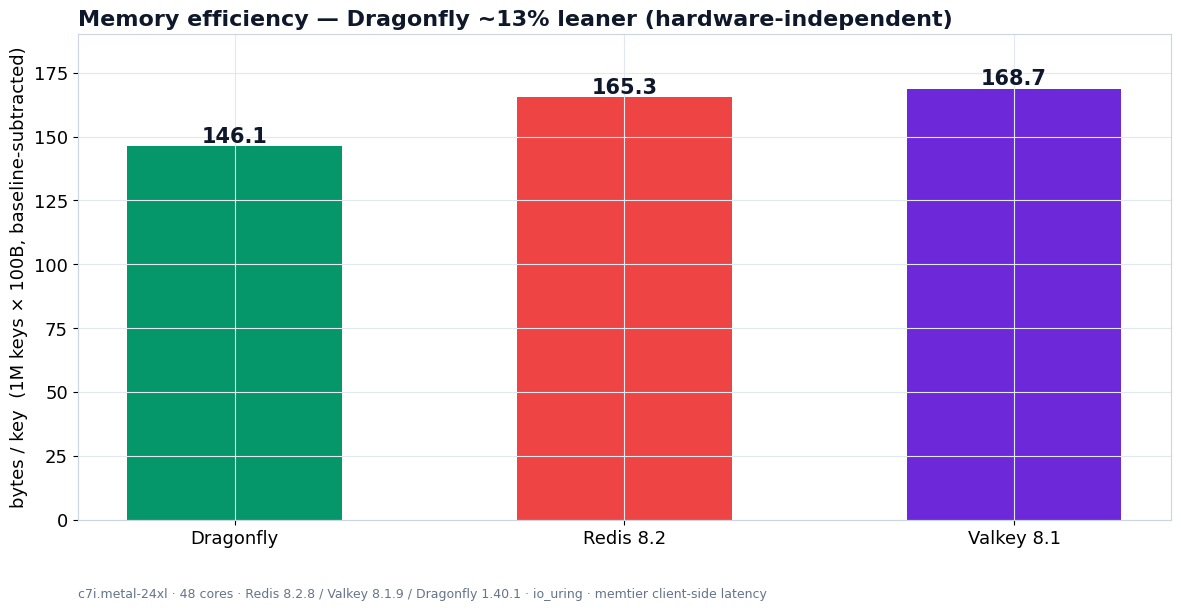
I loaded 1,000,000 keys × 100-byte values into each engine, subtracted the empty-server baseline, and divided by key count:
| Engine | bytes / key | vs Dragonfly |
|---|---|---|
| Dragonfly | 146.1 | — |
| Redis 8.2 | 165.3 | +13% |
| Valkey 8.1 | 168.7 | +15% |
Dragonfly stores the same data in ~12–13% less memory than Redis, and a bit less than Valkey.
Why this one is trustworthy
Two reasons I trust this number more than any throughput number:
- It's hardware-independent. I got 146.1 / 165.3 / 168.7 on my laptop and 146.1 / 165.3 / 168.7 on the c7i.metal box — to the decimal. Memory layout doesn't care about cores, io_uring, or how big your client is. There's nothing to "drive" and nothing to get wrong.
- It's methodology-proof. No pipelining, no cluster routing, no client bottleneck — just "store a million keys, read the memory counter." The only care needed is subtracting the empty baseline and loading exactly N distinct keys (an easy thing to get wrong — load them in parallel with overlapping ranges and you'll silently store far fewer).
What it means (and doesn't)
Dragonfly's edge comes from more compact internal data structures. For a 100-byte value, ~46–69 bytes of per-key overhead sits on top of the payload, and Dragonfly carries less of it.
Two honest qualifiers:
- The percentage shrinks as values grow. At 100 B, overhead is a big fraction of each key; at 10 KB values it's noise. Memory efficiency matters most for many-small-keys workloads (sessions, counters, feature flags, rate-limit buckets) — exactly where you also have the most keys.
- 13% is real money at scale but not a headline-grabber. On a 256 GB dataset it's ~33 GB — a meaningful instance-size difference. It won't decide an architecture on its own, but it's a steady, dependable point in Dragonfly's favor that no amount of benchmarking dispute can erode.
Next: Part 6 — operational simplicity, where the cluster's cross-key limitations get quantified — and where Dragonfly's real structural advantage lives.
About the author
I'm Sunny Sahijwani — a senior backend & DevOps engineer.
👉 Connect with me on LinkedIn — I'm always happy to talk in-memory databases, performance, and systems architecture.
The full harness, pinned versions, and raw data for this benchmark are public on GitHub — rerun it and tell me where I'm wrong.